
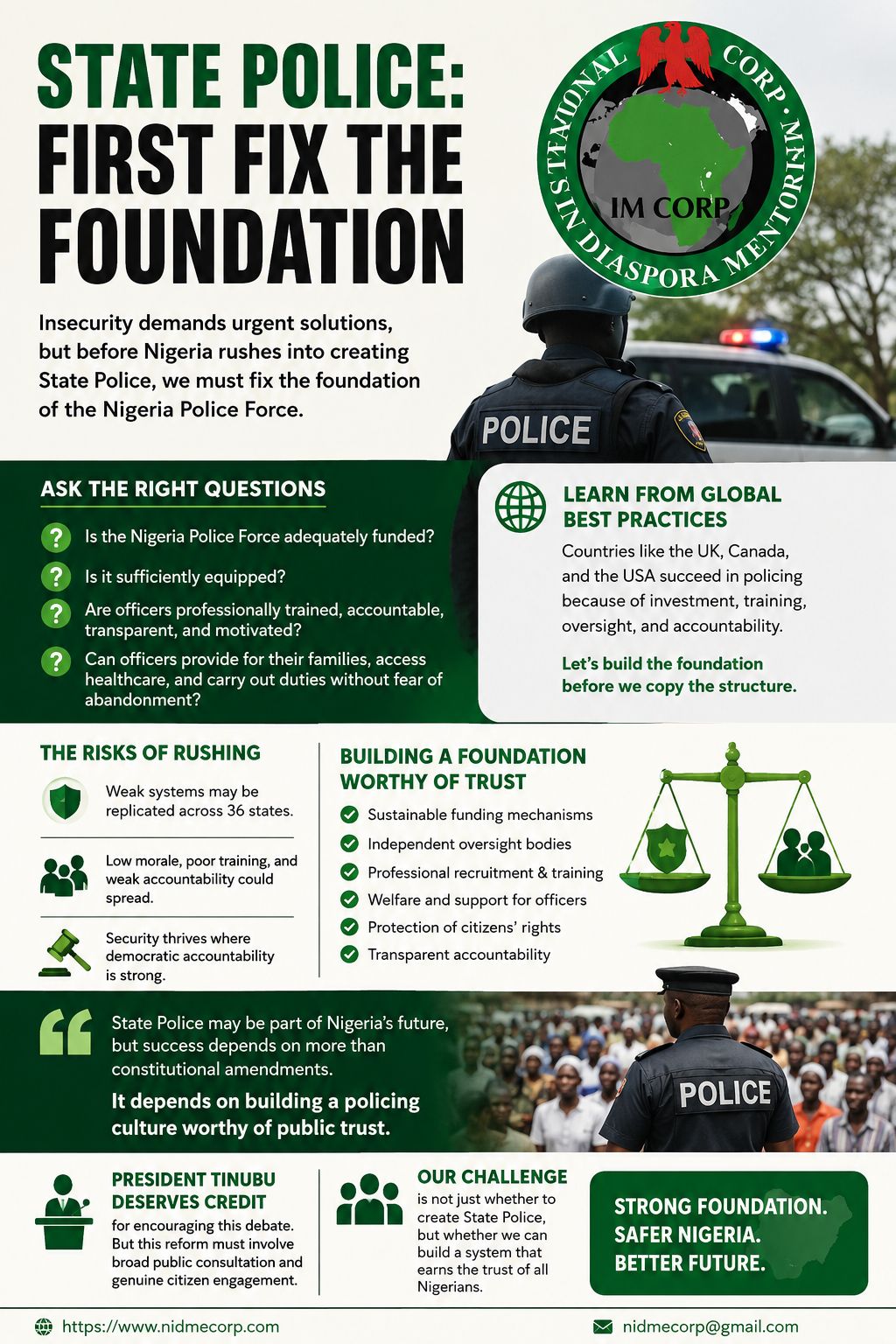
State Police: First Fix The Foundation
The growing momentum behind State Police represents one of the most significant governance conversations in Nigeria since the return to democratic rule in 1999. There is no doubt that insecurity demands urgent and innovative solutions. However, before Nigeria rushes into creating State Police, the nation must answer a few uncomfortable but necessary questions.
Is the Nigeria Police Force today adequately funded? Is it sufficiently equipped? Are officers professionally trained, accountable, transparent, and motivated? Can the average police officer comfortably provide for his or her family, educate children, access decent healthcare, and carry out duties without fear of abandonment if injured or killed in service?
If Nigerians answer these questions honestly, then the debate about State Police becomes far more complex.
Around the world, policing succeeds not simply because of structure but because of investment, professionalism, and accountability. In countries such as the United Kingdom, Canada, and the United States, local and regional police services operate within robust systems of training, oversight, welfare provision, and independent scrutiny. Officers are generally well-equipped, continuously trained, and supported by institutions that enforce professional standards.
Nigeria must therefore ask: are we attempting to copy the structure without first building the foundation?
A poorly resourced federal police force transferred into state structures may simply reproduce existing weaknesses across thirty-six states. (Unless if we are saying the Nigeria Police does not need anything to make it stronger and better.) Low morale, inadequate training, poor welfare, and weak accountability could spread rather than disappear.
Another concern is governance. Nigerians have witnessed instances where public institutions, selected VIPs, political parties, and even elected leaders have been accused of disregarding due process, internal rules, or court decisions. Security, (which counts as any nation’s defence mechanism as top priority), management cannot thrive where democratic accountability is weak. The power to police citizens must be balanced by strong safeguards against abuse.
State Police may indeed become part of Nigeria’s future security architecture. However, success will depend on more than constitutional amendments. It will require clear funding mechanisms, independent oversight bodies, professional recruitment systems, national training standards, and protection of citizens’ rights regardless of any form of affiliation.
President Bola A. Tinubu deserves credit for encouraging debate on a matter many administrations avoided. Yet this reform should not be driven solely by political consensus among elites or ministry’s paths. It must involve broad public consultation and genuine citizen engagement.
The challenge before Nigeria is not merely whether to create State Police. The challenge is whether Nigeria can first build a policing culture worthy of public trust.
Without that foundation, changing the structure alone may change very little.
END!
_Mentoring Cmdt Alistair writes from the Diaspora