
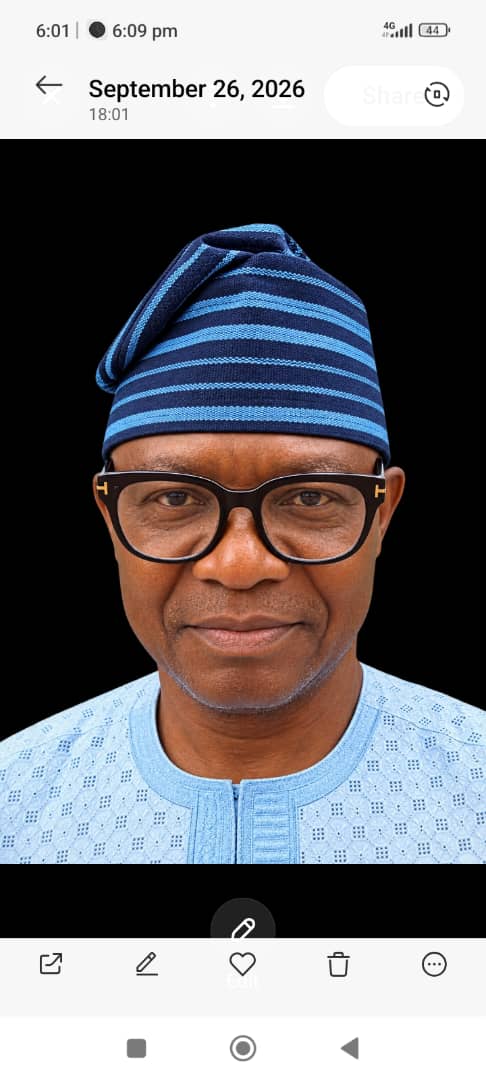
By Hon. Dr. Ife Arowosoge
Edited Version
I warmly salute and congratulate the good people of Ekiti State as we celebrate 30 years of the creation of our dear Ekiti State. This is not only a moment for celebration, but also an opportunity to reflect on the history, sacrifices and struggles that eventually gave birth to the state on 1 October 1996.
The brief account I am presenting today is particularly directed at the younger generation of Ekiti. Those who were about ten years old when Ekiti State was created in 1996 are today full-grown adults, many of whom may know little or only fragments of the long journey that preceded the creation of the state. It is therefore important that they have access to a correct, clear and chronological account of the struggle, presented in a nutshell, so that they can understand where we came from, appreciate the efforts of those who contributed to the struggle, and preserve the history for generations yet unborn.
As we celebrate Ekiti at 30, therefore, let us remember that the state we enjoy today did not emerge by accident. It was the product of years of agitation, advocacy, political action, consultations, organisation and sacrifice by people who believed that the Ekiti people deserved a state of their own.
What follows is a brief attempt to put the struggle into a chronological perspective and to acknowledge some of the principal individuals and organisations that played significant roles in the journey.
*FIRST PHASE: 1980–1983 — THE BEGINNING OF THE STRUGGLE*
A natural question arises: Why did the Ekiti people begin agitating for their own state in 1980, only four years after the creation of Ondo State in 1976, the state to which they belonged?
The answer lies largely in what the Ekiti people perceived as unexpected and disproportionate marginalisation within the newly created Ondo State—marginalisation which, in their view, was even greater than what they had experienced in the old Western Region.
At the time, the Ekiti population constituted approximately _52 per cent_ of the population of Ondo State, while the non-Ekiti areas constituted about _48 per cent._ Yet, according to the perception of the Ekiti leadership at the time, the distribution of political appointments, budgetary resources and industrial projects did not reflect this demographic weight.
Rather than treating Ondo State broadly as comprising two major components—Ekiti and non-Ekiti—the Ekiti people believed that the state was, in practice, being treated as though it consisted of five imaginary regions: Akoko, Akure/Owo, Ondo/Idanre, Okitipupa/Igbokoda and Ekiti.
In this arrangement, Ekiti felt that it was being treated as merely one of five units, rather than as a component representing more than half of the state’s population.
This perceived imbalance became particularly contentious following the first budget of Chief Adekunle Ajasin’s administration in 1979. The Ekiti leadership protested what it regarded as inadequate consideration of Ekiti’s population and contribution to the state.
Rather than resolving the disagreement through dialogue, the response of the government was perceived by the Ekiti leaders as heavy-handed. The controversy reportedly included criticism of the accuracy of the population figures attributed to Ekiti, with suggestions that the population had been exaggerated or “bloated.”
This development caused considerable resentment among Ekiti leaders. They questioned why a population that had been politically important during elections could subsequently be regarded as exaggerated when questions of representation and resource allocation arose.
It was against this background that the first organised demand for Ekiti State began to take shape.
The agitation was led by the then Deputy Governor of Ondo State, Chief Akin Omoboriowo, who, together with *High Chief Joshua Akanbi Ojo (Eisaba of Ikoro Ekiti)* and other Ekiti leaders, pursued the demand for a separate state.
A formal request for the creation of Ekiti State was subsequently prepared and submitted through Chief Adekunle Ajasin, the Governor of Ondo State, to the Federal Government. This marked a significant turning point in the history of the agitation.
The Governor’s reaction was, however, described by the Ekiti agitators as hostile. Rather than allowing the demand to develop into a broader political discussion, the government took disciplinary action against some of the leading figures associated with the agitation. Several prominent Ekiti sons and daughters subsequently suffered removal from public offices or other forms of official pressure because of their support for the creation of Ekiti State.
Among those affected were:
*High Chief Joshua Akanbi Ojo (Eisaba of Ikoro Ekiti)* of Ilawe-Ekiti — removed as Commissioner for Statistics and Economic Planning.
Chief Babatunde of Ado-Ekiti — removed as Commissioner for Health
Chief Falodun of Ayede — removed as Commissioner for Education.
Chief Babatola, the Olora of Ado-Ekiti — removed as Chairman of a state parastatal. He had previously served as a Minister in the First Republic.
Prince Adebanbi Adefajo —removed as Chairman of Water Corporation Board.
There were also members of the Ondo State House of Assembly of Ekiti extraction who quietly supported and cooperated with the agitation.
The events of this early phase created an unresolved political crisis within the leadership of the Unity Party of Nigeria (UPN) and eventually contributed to the decision by some of the leading agitators to leave the UPN and join the National Party of Nigeria (NPN).
*SECOND PHASE: THE BIRTH OF “THE CONFEDERATE”, 1988–1990*
On 31 December 1983, the military junta led by Major General Muhammadu Buhari took over the government through a coup d’état. Following the coup, several prominent political figures, including Governor Adekunle Ajasin, Chief Akin Omoboriowo, and *High Chief Joshua Akanbi Ojo (Eisaba of Ikoro Ekiti)*, who had been appointed Minister of Science and Technology by President Shehu Shagari of the National Party of Nigeria (NPN), were arrested and detained at Kirikiri Maximum Security Prison in Lagos. They remained in detention for about two years, until the palace coup of August 1985, when General Ibrahim Badamasi Babangida overthrew Buhari’s government.
A few years after the trauma of imprisonment had subsided, the Confederate Movement emerged to continue the agitation for the creation of Ekiti State, but this time under the guidance and direction of Ekiti traditional rulers.
_Chairman of the Organisation:_ His Royal Majesty, Oba Adegboye Akaiyejo, the Ogoga of Ikere-Ekiti
_Convener:_ *High Chief Joshua Akanbi Ojo (Eisaba of Ikoro Ekiti)*
_Prominent Leaders:_ Chief Jonny Ajayi of Ikole, Prince Adebanbi Adefajo of Moba, Chief Oladeji Fasuan of Afao, Alhaji Chief Baasaya Shehu Ajijola of Ado-Ekiti, Chief O. Okeya of Ise/Emure, Chief Mrs Bola Omojola, Mrs Onipede among others
Though The Confederate provided an important platform through which the agitation survived, detractors portrayed the agitation as a political gathering, petitioned the Government, prompting the State Security Service (SSS) to go after the leadership of the organisation, particularly *High Chief Joshua Akanbi Ojo (Eisaba of Ikoro Ekiti)*, who was a banned politician at the time. The SSS subsequently barricaded the Ogoga’s Palace in Ikere-Ekiti for several months, effectively disrupting the activities of the organisation and bringing the Confederate movement to a halt.
*THIRD PHASE: 1991–1996*
The third phase saw the emergence of more structured organisations dedicated to the creation of Ekiti State.
*THE EKITI GRAND ALLIANCE (EGA) – Established: 1991*
The Ekiti Grand Alliance was essentially an elite and leaders’ organisation devoted to advancing the cause of Ekiti State creation.
_Convener:_ *High Chief Joshua Akanbi Ojo (Eisaba of Ikoro Ekiti)*
_Chairman:_ Chief Alhaji Baasaya Shehu Ajijola
_Secretary:_ Dr. Ifeoluwa Arowosoge of Ilawe
*THE EKITI FORUM – Established: 1991*
The Ekiti Forum was established principally to take the agitation for the creation of Ekiti State beyond the circle of prominent leaders and intellectuals and to establish a strong grassroots presence.
_Convener:_ *High Chief Joshua Akanbi Ojo (Eisaba of Ikoro Ekiti)*
_Chairman:_ Chief Jonny Ajayi
_Secretary:_ Dr. Dare Teniola.
*THE WEDNESDAY GROUP – Established: 1992*
The Wednesday Group was a think-tank comprising a few prominent Ekiti elites who met regularly on Wednesdays to deliberate on strategies for achieving the creation of Ekiti State.
_Convener:_ Chief Oladeji Fasuan
_Other members included:_ Dr. Aladetoyinbo, Chief Ayo Omodara, Dr. Ife Arowosoge, Chief Ogundana and a few others.
*COMMITTEE FOR THE CREATION OF EKITI STATE – Established: 1995*
The Committee for the Creation of Ekiti State represented the culmination of the organisational efforts of the Ekiti Forum, Ekiti Grand Alliance and the Wednesday Group.
_Principal Officers_
Chairman: Chief Oladeji Fasuan
Deputy Chairman: Chief Jonny Ajayi
First Secretary: Dr. Dare Teniola
Second Secretary and Secretary till creation of the State: Hon. Biodun Oyebanji (now Governor of Ekiti State).
_CENTRAL WORKING COMMITTEE_
Ado LGA: Alhaji Chief Baasaya Shehu Ajijola
Irepodun/Ifelodun: Chief Oladeji Fasuan
Ekiti West: Dr. Chief Kunle Olajide
Ijero: Dr. Dare Teniola
Ekiti South-West: *High Chief Joshua Akanbi Ojo (Eisaba of Ikoro Ekiti)*
Ekiti South (Ikere): Chief Sesan Fatoba
Ise/Emure: Hon. Chief O. Okeya
Ekiti East: Prof. Joseph Oluwasanmi
Ikole: Chief Jonny Ajayi
Oye: Chief Ayo Ogunlade
Ido-Osi: Prof. Tunde Adeniran
Moba: Prince Adebanbi Adefajo
*LEADERSHIP OF THE STRUGGLE*
OVERALL (TRADITIONAL) LEADERSHIP
The traditional rulers of Ekiti, led by the Kabiyesi, the Ewi of Ado-Ekiti, His Majesty Oba Rufus Adeyemo Adejugbe Aladesanmi III, CON, JP, provided the overall traditional leadership and moral authority for the agitation.
POLITICAL LEADERSHIP
First Phase: Chief Akin Omoboriowo was the undisputed and highly visible leader of the first phase.
Second and Third Phases: The second and third phases of the agitation were led by *High Chief Joshua Akanbi Ojo (Eisaba of Ikoro Ekiti)*, who played a prominent financial role in executing the plan.He also provided strategic political direction and sustain the movement during these critical periods.
High Chief Joshua Akanbi Ojo’s extensive political relationships enabled him to establish important links with influential political figures in Northern Nigeria. Among them were Dr. Chief Olusola Saraki, who was Senate Leader during the Second Republic, as well as Dr. Dalhatu Tafida and Alhaji Adamu Ciroma, who served respectively as Minister of Health and Minister of Agriculture under General Sani Abacha.
His relationships and political associations with several of these Northern leaders dated back to the NPN and NRC eras. These longstanding connections provided valuable channels for dialogue, advocacy, and engagement with influential political figures outside the proposed Ekiti area.
High Chief Joshua Akanbi Ojo,The Eisaba of Ikoro Ekiti, also played a significant financial role in sustaining the agitation during these phases. He provided funds to support several activities and initiatives undertaken by the movement, thereby contributing materially to the continuity of the struggle.
His political networks, strategic interventions, and financial support made him one of the key figures in the second and third phases of the campaign for the creation of Ekiti State.
*PROFESSIONAL LEADERSHIP – Chief Afe Babalola, SAN*
Chief Afe Babalola, SAN, played an important professional, legal, and advocacy role. One of his significant contributions was his appearance before the Justice Ayo Nbanefo State Creation Committee, established by General Sani Abacha.
*TECHNOCRATIC LEADERSHIP – Chief Oladeji Fasuan*
Chief Fasuan’s contribution represented the technocratic and organisational dimension of the struggle.
*OTHER INFLUENTIAL FIGURES, EKITI REPRESENTATION AT THE 1994/1995 NATIONAL CONSTITUTIONAL CONFERENCE, AND EVANGELIST BAMIDELE OLUMILUA* remain as chronicled in the original account, forming part of the broader process that eventually led to the creation of the state.
*CONCLUSION*
The creation of Ekiti State was not the achievement of one individual, one political party, one organisation or one generation. It was the culmination of a long, difficult and sustained struggle in which traditional rulers, politicians, professionals, academics, technocrats, civil servants, community leaders and grassroots mobilisers each played different roles at different stages.
On 1 October 1996, when General Sani Abacha announced the creation of Ekiti State, a dream that had been pursued for many years finally became a political reality.
As Ekiti celebrates 30 years, the responsibility of the present generation is not merely to celebrate the achievements of the past but also to preserve the truth about how the state came into being.
Happy 30th Anniversary to Ekiti State.
Long live Ekiti State.
Long live the people of Ekiti. PUBLISHED BY; ISAPOL CONSULTANCY INFORMATION AND COMMUNICATION FIRM